Z00 News
Burmese Python Regenerates Part of Severed Tongue
A short communication by MBRZ staff has been published in The Herpetological Bulletin describing an unusual case of tongue regeneration in a Burmese python Python bivittatus.
The article documents a Burmese python that was rehomed to Midlands Zoo several months after an enclosure accident had severed both tips of its tongue. Over time, the damaged tissue partially regenerated, although only a single tongue tine regrew. Despite the injury, the python has continued to feed, grow and thrive.
Reports of tissue regeneration in snakes are exceptionally rare, making observations such as this valuable additions to our understanding of reptile biology and healing.
The article is available in The Herpetological Bulletin

New Research on Spider Venom Published
New Research on Spider Venom Published
In this study, we investigated the relationship between LD₅₀ (the dose needed to kill 50% of prey) and PD₅₀ (the dose needed to paralyse 50% of prey) in spider venom. LD₅₀ values are often used to measure venom potency, but their ecological relevance has been debated. Our results showed a strong link between the two measures, suggesting that LD₅₀ can be a useful indicator of how effectively a venom works in a real-world prey context
The study was carried out in collaboration with Dr Keith Lyons and Dr Michel Dugon of the Venom Systems Lab, University of Galway.
The paper is Open Access and available for FREE at the following link: Toxicon: X

MBRZ-Associated Conservation Research Published
Our latest research has just been published in Ecology and Evolution:
“Survey of Synanthropic Spiders in Ireland Reveals Expansion and Dominance of the Invasive Noble False Widow Steatoda nobilis in Urban Habitats (Araneae: Theridiidae)”
At MBRZ, we are studying how urban environments affect both native and non-native spiders in Ireland. Since the 1990s, the noble false widow spider Steatoda nobilis has successfully colonised much of the island, including areas where it was never recorded before. Its abundance suggests it may be negatively impacting native spider species, potentially outcompeting them for space and resources.
Through our research, we are monitoring these changes and raising awareness of the species’ impact, supporting the case for its recognition and immediate action as an “invasive alien species” under the UN Convention on Biological Diversity. By understanding these dynamics, MBRZ and collaborators are helping protect native wildlife and guide conservation strategies.
This study was led by our collaborators, PhD candidate Brandon Collier and Dr Michel Dugon from the Venom Systems Lab at the University of Galway
The paper is Open Access and available for FREE at the following link: Ecology and Evolution

MBRZ Research published
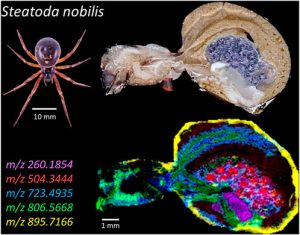
Our latest research has just been published in Frontiers in Chemistry:
“𝗢𝗿𝗴𝗮𝗻-𝗿𝗲𝘀𝗼𝗹𝘃𝗲𝗱 𝗹𝗶𝗽𝗶𝗱 𝗺𝗮𝗽𝗽𝗶𝗻𝗴 𝗶𝗻 𝗦𝘁𝗲𝗮𝘁𝗼𝗱𝗮 𝗻𝗼𝗯𝗶𝗹𝗶𝘀 𝘀𝗽𝗶𝗱𝗲𝗿 𝗺𝗼𝗱𝗲𝗹 𝘂𝘀𝗶𝗻𝗴 𝗵𝗶𝗴𝗵-𝗿𝗲𝘀𝗼𝗹𝘂𝘁𝗶𝗼𝗻 𝗺𝗮𝘀𝘀 𝘀𝗽𝗲𝗰𝘁𝗿𝗼𝗺𝗲𝘁𝗿𝘆 𝗶𝗺𝗮𝗴𝗶𝗻𝗴 𝗮𝗻𝗱 𝗞𝗲𝗻𝗱𝗿𝗶𝗰𝗸 𝗺𝗮𝘀𝘀 𝗱𝗲𝗳𝗲𝗰𝘁 𝗮𝗻𝗮𝗹𝘆𝘀𝗶𝘀”
Steatoda nobilis (the noble false widow spider) is an invasive species that has become increasingly important to study, both for its potential impact on human health and on the environment. While scientists have studied its venom, very little was known about the spider’s internal chemistry.
In this research, we used advanced imaging techniques to create detailed maps of the spider’s body chemistry at the level of individual organs. This allowed us to see how different fats and molecules are distributed in places like the silk glands, ovaries, and nervous system. Importantly, our approach preserved the delicate internal structures of the spider during preparation, giving us clearer results.
These findings not only reveal new insights into the spider itself but also show that our method could be used to study the internal chemistry of other small animals that were previously too difficult to analyse in this way.
After several years of work, this project came to life thanks to fantastic collaborations with the Venom Systems Lab at the University of Galway led by Dr Michel Dugon and the Mass Spectrometry Laboratory at the University of Liège led by Prof. Loïc Quinton.
The paper is Open Access and available for FREE at the following link: Frontiers In Chemistry
MBRZ is now operating under a Zoo Licence
The Midlands Bug & Reptile Zoo is licenced by the Department of Housing, Local Government & Heritage under the European Communities (Licensing and Inspection of Zoos) Regulations, 2003: (S.I. No. 440 of 2003)